Written by Natalie Shtangrud, Senior in Los Angeles Unified School District (JUNE 2022)
As someone who just finished high school, I can tell you from experience that our public schools are severely underfunded in mental health resources and arts education. As students, we have the right to heal, grow, and express ourselves through a creative outlet, but this is not possible when our education policymakers continue to prioritize funding for cops in our schools.
In the wake of the Uvalde, Texas school shooting, attention is focused on the safety of students and how education policymakers continue to fail to keep us safe. This got the attention of Last Week Tonight with John Oliver, where Oliver points to an ACLU report called Cops and No Counselors, stating that 14 million students are in schools with police but no counselors, nurses, psychologists, or social workers. This is heartbreaking.
Police do not belong in our schools. What do belong in schools are art teachers, dance classes, and choir groups.
The arts transform the lives of students. I know this because the arts transformed my life. When I entered elementary school as an English learner, the cacophony of unfamiliar vocabulary surrounding me at school felt like I was drowning in my own voice. I felt as though I couldn’t succeed in the classroom.
This changed once I joined a local choir in the first grade. Perfect English no longer seemed the only priority. I found a genuine passion for choral music and my first community – one that supported me and encouraged my growing confidence. I have been singing in this choir for twelve years and I continue to find solace and joy in every song.
The arts became my strength. However, it was a superpower I found outside of school. In elementary school, I wasn’t allowed to participate in orchestra because of the low supply of available instruments. As an English learner/ English as a Second Language student who needed “more time in class,” I was given the last priority to join.
The arts should be a fundamental part of all students’ education, not an opportunity afforded to a select few. Research demonstrates the arts develop students’ critical thinking, imagination, self-esteem, empathy, and academic and personal success.
In Los Angeles Unified School District (LAUSD), the nation’s second-largest school district, students receive different levels of access to an arts education. Students who are low-income, of color, English learners, incarcerated, unhoused, and/or have a disability, are less likely to have access to arts in their schools. The disparity in who receives an arts education perpetuates the separate and unequal education system that this nation was founded on.
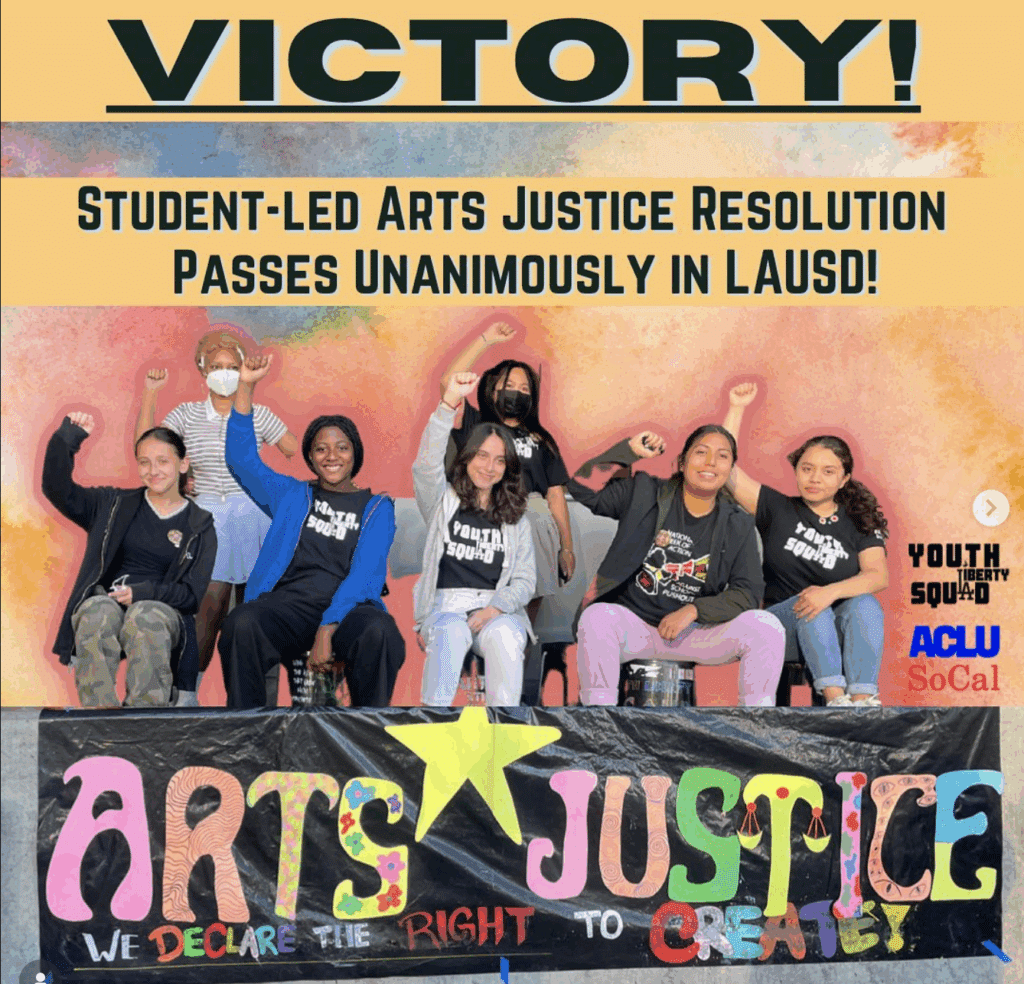
My fellow Youth Liberty Squad, a group of high school student activists, have called their schools “creative dead zones” because of the lack of arts. LAUSD spends nearly twice as much funding on school police than arts education. This means that LAUSD students are more likely to have a cop at their school than a dance or theater teacher.
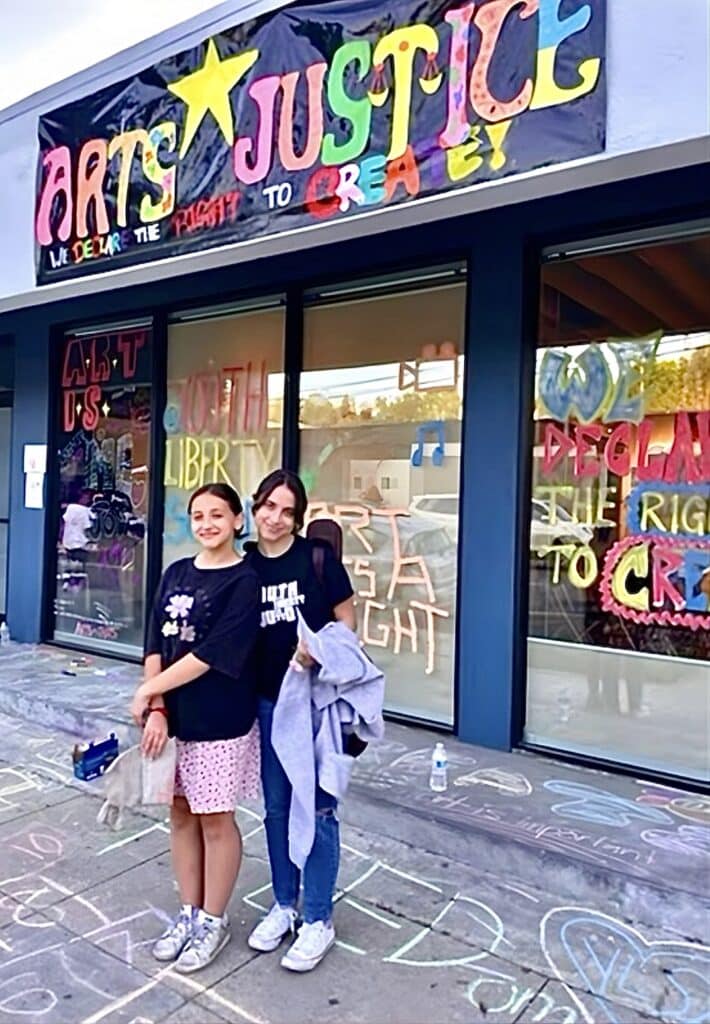
In hopes of bringing arts education to LAUSD, I reached out to Dr. Amir Whitaker, Senior Policy Counsel at the ACLU of Southern California who had been leading the #ArtsJustice movement with students. I was inspired by a statewide petition students delivered to elected officials and I began drafting an Arts Justice School Board Resolution for LAUSD with my peers. More than a year later, the resolution, officially titled “Arts Justice: Access and Equity Across the Disciplines and the District,” passed in LAUSD on May 10th, 2022.
The Arts Justice Resolution aims to respond to gaps in access across the district by not only analyzing and reporting the state of the arts in LAUSD following distance learning, but amplifying student and teacher voices.
The California Education Code requires that all schools provide “instruction in the subjects of dance, music, theater, and visual arts.” However, over 80% of schools fail to provide this complete arts education to students. Schools de-emphasize creativity in favor of quantifiable academic achievement. Our resolution works to create an infrastructure to ensure all LAUSD students are afforded a complete arts education through the Arts Advisory Council, which informs arts justice-related decisions. It also calls for the district to provide additional arts opportunities for students through school-site partnerships.
Over 35 organizations signed on in support of the resolution along with a demand that LAUSD double their arts education funding to match the pre-2008 levels.
The journey of drafting this resolution has been extensive, educational, and incredibly rewarding. I had the opportunity to meet with Board Member Tanya Ortiz Franklin (co-sponsor), speak with representatives from the United Teachers Los Angeles, and give my testimony through public comment at multiple school board meetings. The best part of all this has been working with powerful student activists who showed me how many people love the arts, and will continue to fight for access to arts education.
While I am thrilled that the resolution passed, the fight for arts justice in LAUSD is far from over. Our original draft of the resolution included significantly more demands that we compromised to be able to pass the resolution. We will continue to push for tangible action next year, such as increased funding for the arts, not just aspirational language.
As we return to in-person learning, students need the arts as a means of creative expression and healing more than ever. Students deserve to feel their hearts well up with joy when choir harmonies click and beam at the audience after an orchestra concert.
Students have a right to arts education, and we demand arts justice in school now.