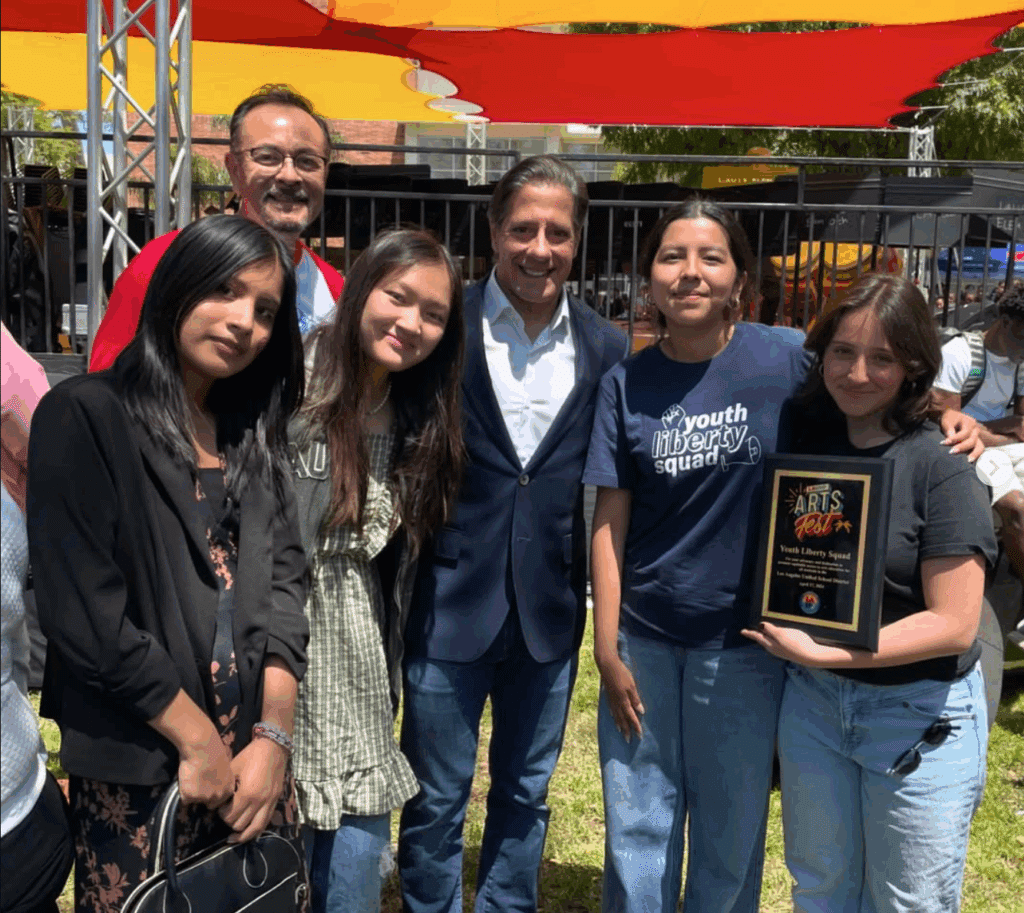
Written by Maya Shtangrud, Senior in the Los Angeles Unified School District (MAY 2025)

The arts changed my life. As a child of immigrants in a low-income household, I entered school speaking little English. It was in an after-school choir that I first discovered my voice, gained confidence, and built my first sense of community. However, such opportunities were not easily accessible in my schools, despite being guaranteed the right to an arts education through the California Education Code §§ 51210/51220. The arts help students grow, find their communities, process emotions, and even make students excited to come to school. However, schools across the city have consistently disregarded the importance of the arts, slashing arts budgets for schools in low-income areas and marginalized communities and creating barriers that make it difficult for students to participate and succeed in the arts.
Determined to make art more accessible to students like myself, I spearheaded the establishment of the Los Angeles Unified School District’s Arts Advisory Council (AAC), a movement made possible by the “Arts Justice: Access and Equity Across the Disciplines and the District” Resolution that the Youth Liberty Squad helped to pass in 2022. The first administrative body of its kind, the mission of the AAC is to facilitate student, educator, and community engagement around arts education in LAUSD, while providing recommendations to the Arts Education Branch and Board of Education. The AAC also exists to promote, protect, and advocate for equitable access to high-quality, standards-based, comprehensive, sequential, culturally relevant, and developmentally appropriate arts education across disciplines for all pre-K-12 students at LAUSD, regardless of socio-economic background.
Despite the council’s exciting ability to include students in discussions regarding educational decision-making, our youth engagement had been wavering. To attract more students as well as hold an in-person event for the very first time, we wanted to hold a meeting dedicated to uplifting student voices at Greenway Court Theater with the opportunity to enter the Melrose Trading Post free of charge after the meeting concluded.
The Melrose Trading Post (MTP) is an arts-based marketplace held every Sunday at Fairfax High School with over 200 local vendors and live music. Long before my work with the AAC, I have loved going to the Melrose Trading Post with my sister and friends, with a Thai tea in hand from a food truck inside the market. Always alive with creative energy, great music, and amazing jewelry finds, the Melrose Trading Post was the perfect spot to engage students interested in the arts as well as have a productive and fun discussion about our experiences in schools.
On April 6, 2025, a group of around 20 students gathered to discuss the importance of the arts, our experience with art classes in school, and potential points of improvement moving forward. LAUSD Arts Administrator Jantre Christian led our discussion and moderated several activities aimed at provoking thoughtful and constructive discussions. One activity involved several students naming topics they were interested in discussing, after which students separated into groups that would discuss the given topic chosen by a peer.
A moment that stood out to me in particular was a discussion I had with a student at Fairfax High School. The group we were in was discussing arts funding in each of the students’ schools, a conversation that then shifted towards the importance of arts in the lives of all students, regardless of their intended careers and socioeconomic background. A student had pointed out that although art classes should be available in schools, they noted that not all students should be required to take them, especially if they are passionate about a career in STEM. This led to an interesting conversation about the role art has in our development and well being, as well as how art is inherent to any career, whether it be creative or scientific/analytical. Through a respectful dialogue, I was amazed at how students eloquently presented their ideas, opinions, and experiences to draw convincing arguments.
Returning to our larger group after these discussions, we had a productive conversation about important points made as well as any disagreements there were between students. In closing, we made our final arguments, calling on leadership to prioritize the arts to support existing and future programs in an understanding that the arts are essential to a student’s academic performance and social/emotional health.
As a whole, this meeting was such a positive and enlightening experience. Not only was it interesting to hear other students’ perspectives, but it was incredibly empowering to be able to directly contact and speak to the very people that influence our education, such as Jantre. With more meetings like this and movements aimed at involving students in decision making, we can create more equitable and productive educational systems.